 Liquidium
Core concepts
Understanding the key terms and concepts.

Pools
What is a pool
A pool is a shared liquidity vault for a specific asset (like BTC, USDT, or ETH). Lenders supply assets to the pool to earn interest, while borrowers supply collateral to access this liquidity and pay interest on their loans. The interest paid by borrowers is distributed to lenders as yield. Each pool operates independently with its own interest rates based on supply and demand.
You can find live pool parameters on the Markets page.
Dynamic interest rates
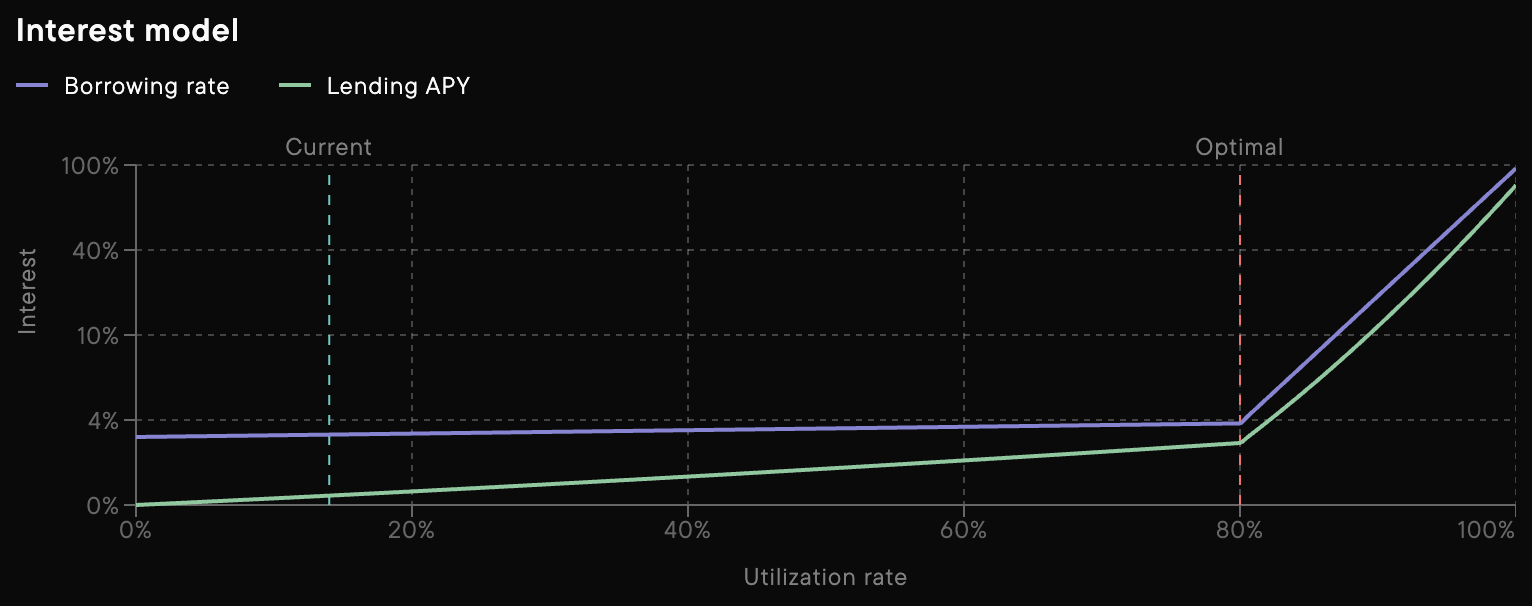
Interest rates in each pool dynamically adjust based on supply and demand to maintain economically optimal conditions and secure the protocol. When utilization is low, rates are kept low to encourage borrowing. As more funds are borrowed and liquidity becomes scarce, rates increase to incentivize repayments and new supply. This creates a self-balancing system that ensures pools always have adequate liquidity for withdrawals while maximizing capital efficiency.
Borrow rate (APY)
The annual percentage yield (APY) applied to borrowed funds follows a dynamic model based on pool utilization:
- Starts with a base rate when utilization is low
- Increases gradually until reaching an "optimal utilization" point
- Accelerates rapidly beyond optimal utilization to encourage repayment
Supply rate (APY)
The annual percentage yield (APY) you earn on your supplied assets. Your earnings come from:
- Interest paid by borrowers in the pool
- Adjusted by how much of the pool is being borrowed
- Net of the protocol fee
APY represents the projected annualized return on your assets, based on the current pool rate and assuming compounding over a one-year period.
Higher utilization generally leads to better supply rates for lenders.
Base Rate
The minimum interest rate applied to a pool, even at very low utilization. This ensures borrowers always pay interest and lenders receive yield.
Utilization Rate
The percentage of a pool's funds that are currently borrowed. This directly affects interest rates:
- Low utilization (e.g., 20%): Plenty of liquidity available, lower rates to encourage borrowing
- High utilization (e.g., 90%): Most funds borrowed, higher rates to encourage repayment
Optimal Utilization Rate
The target utilization level marks where interest rates change sharply. Below this point, rates grow slowly; above it, they increase rapidly to maintain pool liquidity.
Liquidation Threshold
Each pool has its own liquidation threshold - the maximum percentage of your collateral value you can borrow before risking liquidation.
These thresholds are set to protect the protocol from market volatility. More stable assets allow higher borrowing ratios.
Supply/Borrow Caps
Maximum limits set on how much can be supplied to or borrowed from each pool. These risk management tools help prevent any single pool from becoming too large relative to the protocol's overall risk profile.
Your profile
Position
Your position tracks your lending and borrowing activity with a specific asset. Each position shows:
- How much you've supplied (deposited)
- How much you've borrowed
- Interest earned on supplies
- Interest owed on borrows
- Your net balance with that asset
You automatically get one position per asset type when you first interact with a pool.
Health factor
Your portfolio health is measured by a Health Factor - a simple number that tells you how safe your borrowing position is:
See advanced Health Factor explanation here.
The UI displays the portfolio health as a percentage, where:
- 100%: No debt - you haven't borrowed anything
- Above 0% to 99%: Your position is safe from liquidation - the higher the percentage, the safer you are
- Close to 0%: You're at risk - the closer to 0%, the higher the liquidation risk
- 0%: Your position can be partially liquidated
You can switch to traditional decimal format in General Settings if you prefer.
Collateral
Collateral is the set of assets backing your borrow positions. When you borrow, all supplied assets automatically count toward collateral. The protocol requires over-collateralization, meaning the total value of your collateral must exceed the value of your borrow to maintain a safety buffer.
Weighted average liquidation threshold
When you have positions across multiple pools, your overall borrowing limit is determined by the weighted average liquidation threshold of all your collateral. This determines your overall health factor and liquidation risk.
Net APY
Combined effect of all supply and borrow positions on net worth.
It is possible to have a negative net APY if you accrue more interest from your debt than you earn from your supplied assets.
Net value
The value of supplied assets minus borrowed positions.
Net interest
Interest earned from supplied assets minus interest due on borrowed assets for open positions. Interest accrues continuously and compounds over time.
If the interest due is higher than the interest earned, the net interest will be negative.
Current pool parameters
The values below reflect the current BTC and USDT market settings:
| Parameter | USDT | BTC |
|---|---|---|
| Max LTV | 65% | 65% |
| Liquidation Threshold | 74% | 74% |
| Liquidation Penalty | 5% | 5% |
| Supply Cap | 20,000,000 | 200 |
| Borrow Cap | 2,000,000 | 30 |
| Reserve Factor | 0% | 0% |
| Borrowing paused | No | No |
| Same asset borrowing | No | No |
| Optimal Utilization | 85% | 80% |
| Base Rate | 0% | 0.1% |
| Slope 1 | 8.5% | 4% |
| Slope 2 | 20% | 60% |
You can find live pool parameters on the Markets page.
Cross-chain architecture
Native assets everywhere
Unlike other platforms that require wrapped tokens or complex bridges, Liquidium lets you use your actual Bitcoin, Ethereum, and other native assets directly. You can:
- Supply Bitcoin from your Bitcoin wallet to earn yield
- Borrow USDT that gets sent to your Ethereum address
- Use your Bitcoin as collateral to borrow assets on other chains
- Perform these actions with any supported asset, no matter which chain it lives on
How it works
The protocol runs on IC (Internet Computer), which can natively interact with other blockchains without trusted intermediaries. Behind the scenes, your native assets are represented as "chain-key assets" (like ckBTC for Bitcoin) - these are 1:1 backed by the real assets and secured by multiple independent nodes working together.
Running everything on IC enables instant liquidations to keep the protocol healthy. While Bitcoin takes 10-40 minutes per transaction and other chains can be slow during congestion, our liquidation system completes full cycles in just 15 seconds thanks to IC's sub-second finality.
From your perspective, it's seamless - just send and receive native tokens as usual. The protocol handles all the complexity.
Learn more about IC's Chain Fusion Technology